
Optimal solutions for applications: Accurate and reliable particle analysis
Accurate particle analysis is crucial for the success of applications in various industries such as chemicals, building materials, mining and food. NEXOPART products help optimize workflows and ensure compliance with safety standards for your application. This is achieved by automating processes and ensuring precise measurements. We also place great importance on individual training and comprehensive service to ensure that you, as a user, can exploit the full potential of our technologies. With a clear focus on precision and innovation, we are setting new standards for the future of laboratory applications.
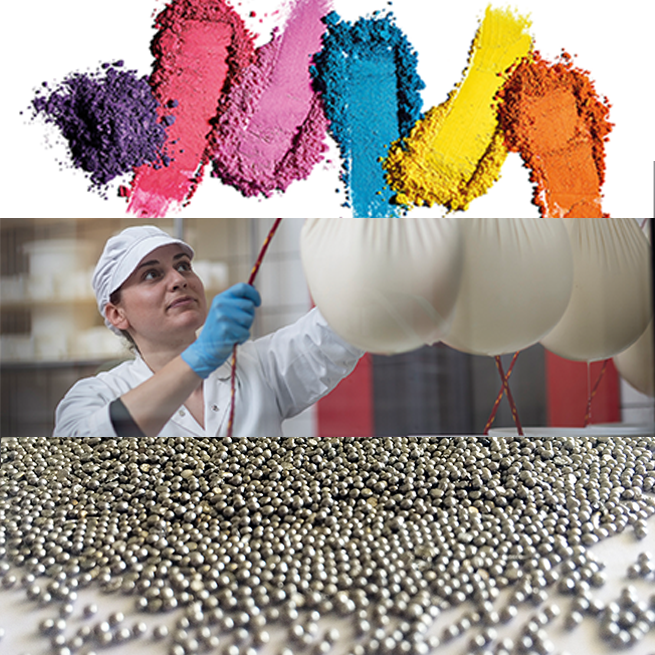

The importance of particle analysis in various industries
How crucial is the right particle analysis for the success of your industry? In a world where quality and efficiency go hand in hand, precise particle analysis is not only a technical necessity, but also a key to innovation and progress. Whether you work in construction, the food industry or chemistry, choosing the right analysis method can mean the difference between success and failure. With solutions from NEXOPART, you can optimize your daily lab routine and take your applications to the next level. Let's explore the possibilities that will help you achieve your goals.
The perfect particle analysis for your application
- Abrasives
- Animal feed
- Blasting abrasive materials
- Chemicals
- Fertilizer
- Foods
- Granulates and pellets
- Minerals and ores
- Paint powders and pigments
- Raw materials
- Recycling products
- Refractories
- Research and education
- Sand, stones, gravel
- Sugar and salt


Cement, concrete and asphalt
Building materials
Powders and paints
Chemistry
Sugar and salt
Food
Ores and Minerals
Mining
Building materials
In construction, the analysis of materials is crucial for the safety and durability of structures. The quality of building materials such as cement, concrete or asphalt depends largely on particle size and distribution. Inadequate analysis of raw material quality can lead to structural weaknesses, which in the worst case can have catastrophic consequences for the building.
Correctly performed particle analysis enables civil engineers and materials scientists to ensure that the materials used meet the required standards. The use of modern analysis methods not only provides a better understanding of the properties of building materials, but also allows their behavior under various conditions to be predicted. This helps to avoid costly rework and extend the service life of structures. Classic sieve analysis with the NEXOPART e200 LS air jet sieve machine is ideally suited for the separation, fractionation and particle size determination of fine to very fine powders in various industries, such as the cement and building materials industry, as it delivers precise, fast and reproducible results.


Chemistry
In chemistry, for example in the manufacture of washing powder, particle size plays a key role in the effectiveness and efficiency of the chemical base material and its additives. The correct granulation of washing powder not only influence its solubility, but also its washing performance. Precise particle analysis helps to determine the optimum size for different applications. In addition, chemical reactions can be specifically controlled by monitoring particle size, which is of great importance in many industrial processes.
Innovative analysis techniques enable chemists to develop new formulations that are both more environmentally friendly and more effective. The NEXOPART vibrating sieve machines of the EML series are ideal for analyzing particles down to 32 µm. During sieving, a sample is passed through a set of sieves with different mesh sizes. This allows particles to be separated into different fractions, enabling fast and cost-effective analysis. Anything finer than 100 µm can also be analyzed with the NEXOPART e200 LS air jet sieve machine.
Industry brochure Chemistry

Learn more about the application in chemistry using the example of washing powder in this brochure.
Download nowFood
In the food industry, particle analysis helps to verify ingredients and ensure food safety. The size, shape and distribution of the particles, such as sugar or salt, can significantly influence the processing and bioavailability of a food. Therefore, it is crucial to choose appropriate analytical methods that allow for accurate characterization of the particles.
Optical methods, for example, are using light to analyze the properties of particles. This includes techniques such as the dynamic image analysis. In dynamic image analysis, an LED light line and a digital line scan camera work together in the backlight process. Each individual particle is scanned and high-resolution readings of the size and shape of the particles are output. This method is particularly precise and is ideally suited for applications in the fertilizer industry, animal feed industry, wood industry, but also in the food industry as with sugar. The ability to analyze very small free-flowing particles is a key advantage of this technique, as it is essential for many modern applications.
The NEXOPART CPA 2-1 laboratory unit provides a fast and fully automated analysis of particle size and shape. The method of dynamic image analysis not only helps with quality control, but also in the research and development of new foods by providing valuable data needed for innovative approaches.


Mining
Particle analysis is a key component in mining for ensuring stable processes and defined product characteristics. Particle size distribution plays a decisive role in the efficiency and economic performance of mineral processing operations. Whether in crushing, classification, flotation, or dewatering, even minor changes in fines content or particle shape can affect energy consumption, throughput, metal recovery, and product quality.
Precise particle analysis provides the foundation for reliable process monitoring and targeted optimization throughout the entire value chain.
The NEXOPART product portfolio offers suitable solutions for a wide range of mining applications. Coarse bulk materials can be analyzed just as reliably as fine particles down to the micrometer range.
The result is improved process stability: energy consumption and wear can be reduced, product quality can be maintained consistently, and deviations can be detected at an early stage. Especially in continuous mineral processing operations, standardized particle analysis enables targeted intervention before significant quality losses occur.
FAQ about applictaion
For which application does NEXOPART offer a solution?
L
What are the advantages of particle analysis for building materials and asphalt?
L
How does particle analysis contribute to quality assurance in the food industry?
L
How does particle analysis work in the pharmaceutical industry?
L
In which areas is particle analysis for fertilizers particularly important?
L
What role does particle analysis play in mineral processing operations in the mining industry?
L
How can laboratory employees benefit from NEXOPART solutions?
L

Whitepaper: Your optimized workflows with the help of dynamic image analysis
Find out here how you can monitor your processes effectively and prevent errors.